time · 2-minute read
Hyperfocus: how to use it, and how to come back out
in 30 seconds
- Hyperfocus is intense focus where everything else fades. It’s a very common ADHD experience, but not an official symptom.
- Research is limited, and there’s no agreed definition yet.
- Plan your exit before you start: alarms, a person who checks in, and the right time of day.
Hyperfocus is getting so absorbed in something that the rest of the world fades: meals, messages, time. Many people with ADHD know it well. It can be useful, and it can cost you sleep or plans. The trick is planning the exit before you go in.
What we know (and don’t)
Understood calls hyperfocus “not an official ADHD symptom”, but a very common experience. Researchers Ashinoff and Abu-Akel reviewed the science in 2021 and found there is still no single agreed definition, and not much research. They also discuss how it overlaps with “flow”.
How to come back out on time
Notice your triggers
Games, research rabbit holes, creative projects, scrolling. Knowing them lets you plan.
Tiny version: Name one trigger.
Use an outside stop
Cleveland Clinic and Understood both suggest alarms, timers and reminders, or a person who calls you.
Tiny version: Put the alarm across the room, so you have to stand up.
Low-energy version: Ask someone to text you at a set time.
Make a when-then plan
Cleveland Clinic suggests “when-then” goals: when the alarm rings, then I stand up and drink water.
Tiny version: Write one when-then sentence.
Pick the right time
Understood advises not starting absorbing activities without enough time. Avoid them right before bed or work.
Tiny version: Move one absorbing thing to a free afternoon.
Use it on purpose
Point hyperfocus at something you care about, inside a timed block.
Tiny version: One 45-minute block for a project you love.
Set your exit before you start
A visual timer with full-screen mode and a soft chime.
Start a 45-minute blockasking someone to be your exit
Could you text me at 6 to remind me to stop and eat? I lose track of time when I’m in the zone.
Questions people ask
Is hyperfocus a superpower?
It can be useful, and it can cost you. It’s more helpful to see it as a strong current you can steer, not a reliable switch.
Can I turn it on when I need it?
Not on demand. Interest, challenge and novelty tend to help (see the interest-based nervous system).
Is it the same as flow?
Researchers discuss overlap between the two, but there’s no settled answer yet.
When to get support: This guide shares everyday strategies, not medical advice. If this is making daily life hard for weeks, talk to a doctor or a mental health professional. If you’re in crisis, you can find free, confidential support in your country at findahelpline.com.
Sources
free printable kit
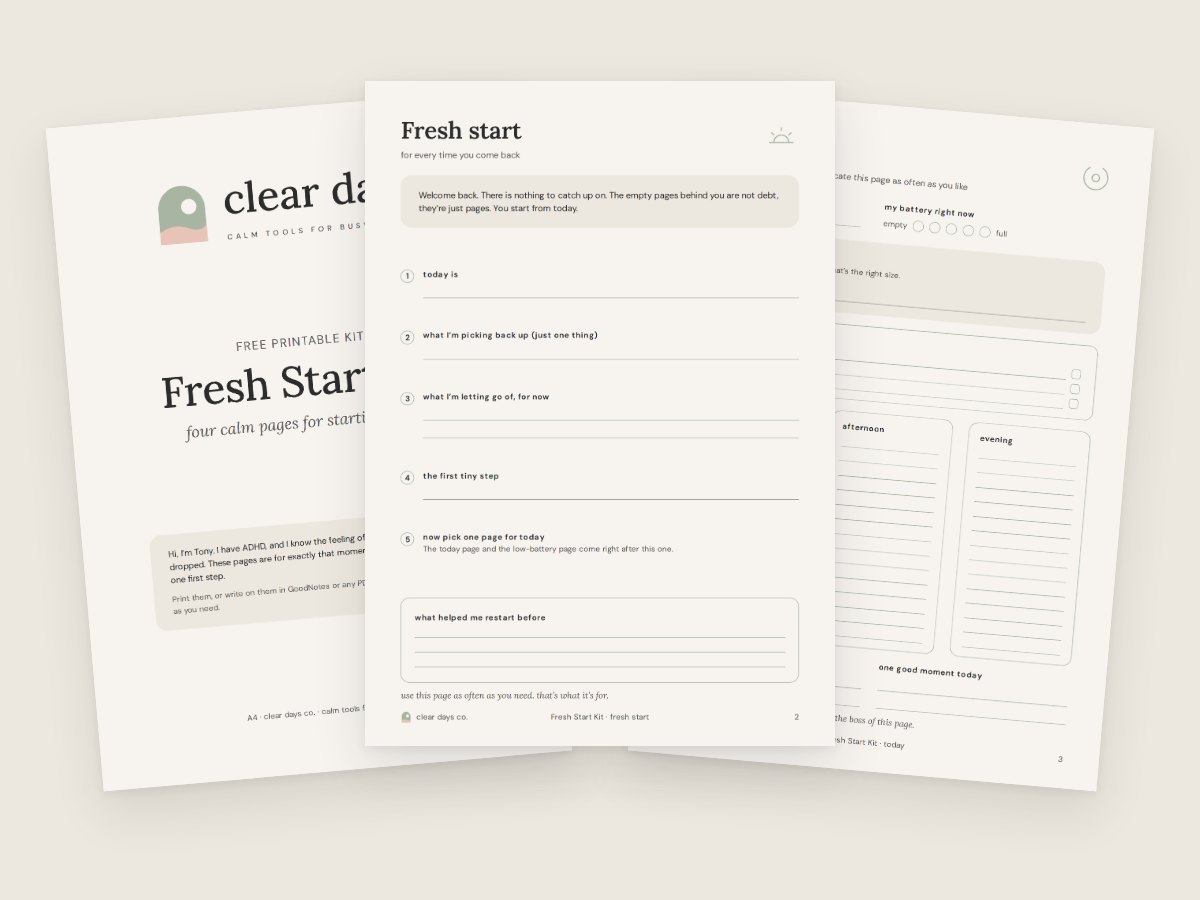
Free: the Fresh Start Kit
Six calm pages for the moment you come back to a plan you dropped: a fresh start page, a one-first-step today page, a low-battery day page and a write-it-all-down page. A4 and US Letter.
Get the free kitNo catching up. Just one first step.